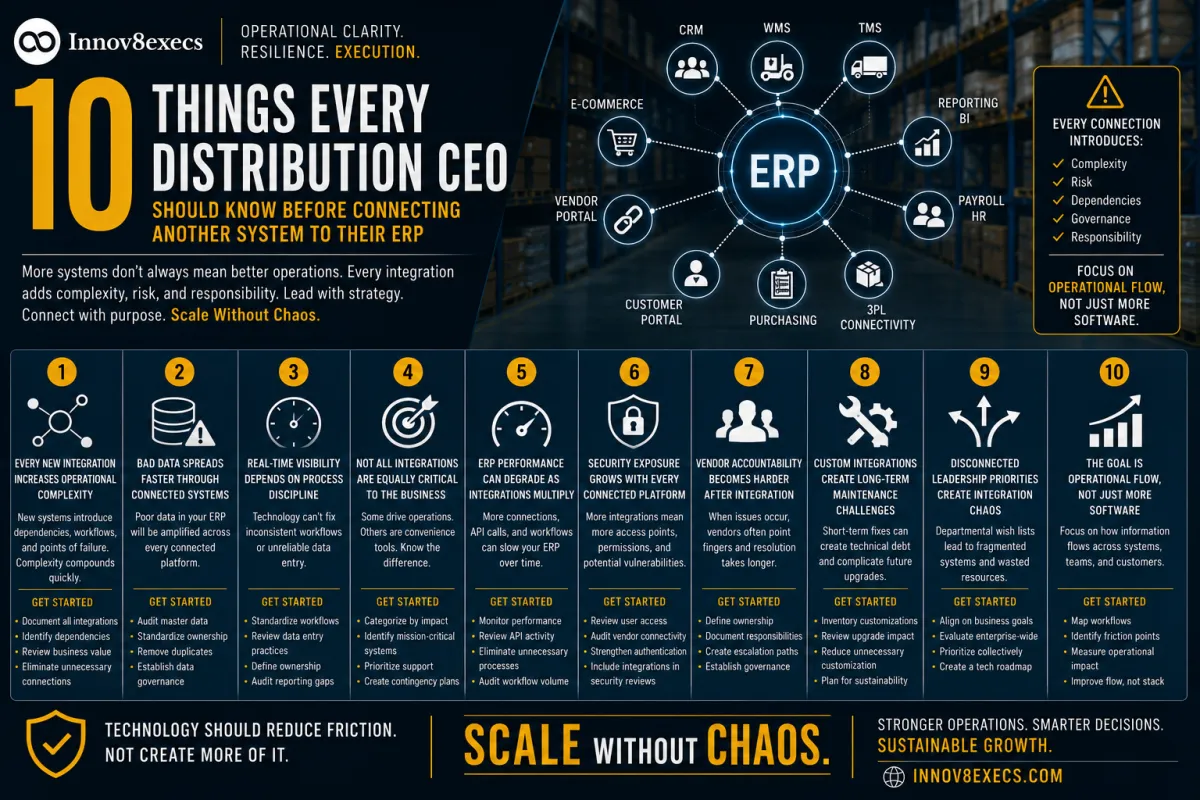
10 Things Every Distribution CEO Should Know Before Connecting Another System to Their ERP
10 Things Every Distribution CEO Should Know Before Connecting Another System to Their ERP
Most distribution companies do not struggle because they lack technology.
They struggle because operational complexity grows faster than leadership realizes.
A new warehouse platform.
A transportation management system.
A customer portal.
A reporting tool.
A procurement solution.
A CRM integration.
Individually, each system solves a problem.
Collectively, they can create a technology ecosystem that becomes increasingly difficult to manage, secure, support, and scale.
The strongest distribution companies understand something many organizations learn too late:
The goal is not to connect more systems. The goal is to improve operational flow.
Every integration should reduce friction. If it adds complexity faster than it creates value, it becomes another operational burden disguised as progress.
Companies like Walmart built supply chain advantages through visibility, process discipline, and operational consistency. Technology played a critical role, but the competitive advantage came from how information flowed across the business, not simply from how many systems were connected.
That lesson matters just as much today.
Here are 10 blind spots every distribution CEO should understand before connecting another system to their ERP.
Blind Spot #1: Every New Integration Increases Operational Complexity
Why It Happens
Most integrations begin with good intentions.
A department identifies a problem and finds software designed to solve it.
The new system promises visibility, automation, efficiency, or reporting improvements.
What often gets overlooked is that every integration introduces:
new workflows,
new dependencies,
new support requirements,
and new failure points.
Complexity compounds much faster than most organizations anticipate.
Why It Matters
When systems become increasingly interconnected, a single issue can impact multiple operational areas simultaneously.
A synchronization issue in one platform may affect:
inventory visibility,
customer service,
fulfillment,
reporting,
or vendor communication.
The more systems connected to the ERP, the more operational discipline becomes necessary.
How to Start Fixing It
Document all existing integrations.
Identify system dependencies.
Review integrations that support critical operations.
Evaluate whether each connection creates measurable business value.
Operational Reality
Complexity is not inherently bad.
Unmanaged complexity is.
Blind Spot #2: Bad Data Spreads Faster Through Connected Systems
Why It Happens
Many organizations assume integration will improve data quality.
In reality, integrations distribute information.
They do not validate it.
If customer records, inventory counts, pricing structures, or vendor data are inaccurate inside the ERP, those problems spread quickly across connected systems.
Why It Matters
Poor data creates:
reporting conflicts,
inventory issues,
customer service challenges,
forecasting errors,
and operational confusion.
Bad information moves faster when systems are connected.
How to Start Fixing It
Audit master data regularly.
Standardize ownership of key data sets.
Eliminate duplicate records.
Establish governance around data quality.
Operational Reality
Integration amplifies data quality.
Good or bad.
Blind Spot #3: Real-Time Visibility Depends on Process Discipline
Why It Happens
Executives often expect instant visibility once systems are integrated.
But visibility depends on more than software.
It depends on people consistently following processes.
If employees enter information inconsistently or workflows vary by location, reporting gaps remain regardless of integration quality.
Why It Matters
Leadership decisions are only as strong as the information supporting them.
Poor process discipline creates delayed visibility and unreliable reporting.
How to Start Fixing It
Standardize workflows across departments.
Review data entry practices.
Define operational ownership.
Audit reporting inconsistencies.
Operational Reality
Technology cannot compensate for broken operational habits.
Blind Spot #4: Not All Integrations Are Equally Critical to the Business
Why It Happens
Many organizations treat all integrations as equally important.
In reality, some systems directly impact:
fulfillment,
shipping,
inventory,
customer service,
and revenue generation.
Others provide convenience rather than operational necessity.
Why It Matters
When resources become limited, leadership must know which integrations support mission-critical workflows.
Not all disruptions carry the same business impact.
How to Start Fixing It
Categorize integrations by business impact.
Identify mission-critical operational dependencies.
Prioritize support and monitoring accordingly.
Review contingency plans for key systems.
Operational Reality
Not every integration deserves equal attention.
Blind Spot #5: ERP Performance Can Degrade as Integrations Multiply
Why It Happens
Every connected platform consumes resources.
Additional API calls, automated workflows, reporting queries, and synchronization processes increase system demand.
Over time, performance degradation often appears gradually.
Why It Matters
Slower ERP performance affects:
order processing,
inventory visibility,
employee productivity,
and customer experience.
Operational frustration often begins with performance issues.
How to Start Fixing It
Review integration performance regularly.
Monitor ERP response times.
Eliminate unnecessary automated processes.
Audit API activity and workflow volume.
Operational Reality
Operational efficiency should not come at the expense of system stability.
Blind Spot #6: Security Exposure Grows With Every Connected Platform
Why It Happens
Every integration introduces:
user permissions,
APIs,
vendor access,
authentication requirements,
and additional attack surfaces.
Security exposure increases with every connection.
Why It Matters
Distribution organizations manage:
customer information,
pricing data,
inventory records,
and supply chain operations.
Weak integration security can quickly become an operational issue.
How to Start Fixing It
Review access permissions regularly.
Audit third-party connectivity.
Require strong authentication controls.
Include integrations in security reviews.
Operational Reality
Every new connection introduces new risk.
Blind Spot #7: Vendor Accountability Becomes Harder After Integration
Why It Happens
When systems stop communicating correctly, responsibility often becomes unclear.
ERP vendors blame integrations.
Integration vendors blame infrastructure.
Service providers blame software.
Meanwhile, operations continue waiting for answers.
Why It Matters
Delayed accountability often extends downtime and increases operational disruption.
How to Start Fixing It
Define ownership before deployment.
Document support responsibilities.
Create escalation paths.
Establish governance for integrated environments.
Operational Reality
Accountability becomes more valuable as complexity increases.
Blind Spot #8: Custom Integrations Create Long-Term Maintenance Challenges
Why It Happens
Custom integrations often solve immediate operational problems.
The challenge appears later.
Updates become harder.
Upgrades become riskier.
Support becomes more dependent on specialized knowledge.
Why It Matters
Technical debt eventually limits scalability and flexibility.
Organizations frequently underestimate future maintenance requirements.
How to Start Fixing It
Inventory custom integrations.
Review upgrade dependencies.
Reduce unnecessary customization.
Prioritize sustainable architecture decisions.
Operational Reality
Short-term convenience often creates long-term complexity.
Blind Spot #9: Disconnected Leadership Priorities Create Integration Chaos
Why It Happens
Sales wants CRM automation.
Operations wants warehouse efficiency.
Finance wants reporting visibility.
Each objective is valid.
Problems emerge when decisions are made independently.
Why It Matters
Disconnected priorities create fragmented technology ecosystems.
The result is operational complexity without operational alignment.
How to Start Fixing It
Create a cross-functional technology strategy.
Align initiatives to business goals.
Evaluate requests through an enterprise lens.
Review priorities collectively.
Operational Reality
Disconnected leadership creates disconnected systems.
Blind Spot #10: The Goal Is Operational Flow, Not Just More Software
Why It Happens
Many organizations evaluate software based on features.
Fewer evaluate it based on operational flow.
The strongest distribution companies focus on how information moves across:
systems,
teams,
workflows,
and customers.
Why It Matters
Operational flow drives:
speed,
visibility,
customer satisfaction,
and scalability.
Software is only valuable when it improves execution.
How to Start Fixing It
Map operational workflows.
Identify friction points.
Evaluate integrations based on business outcomes.
Measure operational impact, not feature counts.
Operational Reality
The objective is not more software.
The objective is less friction.
Final Thought
Most distribution companies do not struggle because they have too few systems.
They struggle because complexity quietly outpaces operational discipline.
Every integration introduces:
dependencies,
governance requirements,
security considerations,
accountability challenges,
and operational risk.
The strongest distribution organizations understand that technology should simplify operations, not complicate them.
Companies that scale successfully build connected operations, not just connected systems.
SCALE WITHOUT CHAOS
is not about adding more software.
It is about creating operational flow across people, processes, and systems.
Before connecting another platform to your ERP, ask a simple question:
Will this improve operational flow, or will it simply add another layer of complexity?
The answer often determines whether technology becomes a growth accelerator or an operational burden.
