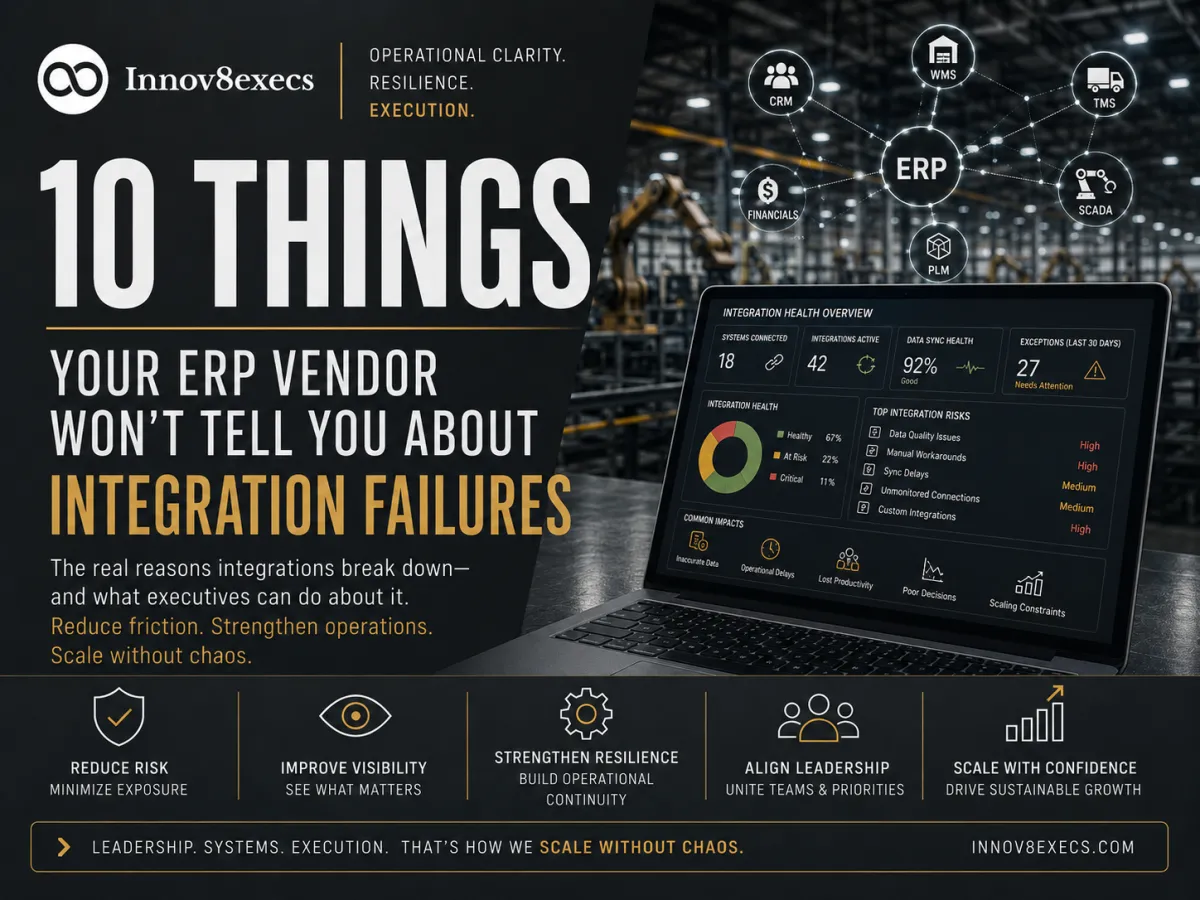
10 things your erp vendor won't tell you
10 Things Your ERP Vendor Won’t Tell You About Integration Failures
Most ERP integration failures are not caused by bad software.
They are caused by operational misalignment that technology eventually exposes.
Disconnected workflows. Conflicting data. Undefined ownership. Spreadsheet dependencies. Departmental silos. Reactive growth. Manual workarounds that quietly become mission-critical processes.
The integration simply becomes the point where those problems collide.
For manufacturing, industrial, and distribution companies, ERP integration is no longer just a technology initiative. It is an operational strategy decision. Every connected system increases dependency across production, inventory, procurement, logistics, finance, customer visibility, and executive reporting.
And the companies that scale successfully understand something many organizations learn too late:
You are not integrating software.
You are integrating operational accountability.
The strongest organizations build integrations around operational flow, governance, and resilience. The weakest ones simply connect systems and hope the business adapts afterward.
Here are 10 things your ERP vendor probably will not tell you about integration failures — and where leadership teams can begin reducing operational drag before complexity starts slowing growth.
1. Most Integration Failures Are Process Failures First, Technology Failures Second
Many organizations assume integrations fail because systems cannot communicate properly.
More often, the real issue is operational inconsistency.
When departments follow different workflows, approvals vary by location, or reporting standards are interpreted differently across teams, integrations simply expose operational fragmentation faster.
Many manufacturers discover integration issues only after systems begin forcing operational consistency the organization never previously needed to define.
Easy First Steps
Map workflows before integrating systems.
Identify where departments follow different operational processes.
Standardize approval and reporting structures.
Review where spreadsheets are compensating for process gaps.
Operational maturity scales better than software customization.
2. “Out-of-the-Box Integration” Rarely Means Plug-and-Play
ERP vendors often describe integrations as seamless.
Manufacturing environments rarely are.
Every organization has:
unique workflows,
operational exceptions,
legacy processes,
customer requirements,
vendor dependencies,
and reporting expectations.
That complexity creates friction long before deployment begins.
Organizations frequently underestimate how much operational alignment is required before systems can exchange reliable information consistently.
Easy First Steps
Audit data consistency before deployment.
Standardize naming conventions and operational definitions.
Review how departments currently use the ERP.
Identify operational exceptions outside documented workflows.
Integration success usually depends more on operational consistency than technical capability.
3. Poor Master Data Quietly Destroys Integration Accuracy
Bad data spreads quickly in connected environments.
When inventory records, customer information, vendor data, pricing structures, or part numbers are inconsistent, integrations amplify those inaccuracies across every connected system.
That creates:
reporting conflicts,
inventory confusion,
operational delays,
procurement mistakes,
and leadership mistrust in the data itself.
Many organizations initially blame integrations when the real issue is years of inconsistent operational data management practices.
The systems may be functioning correctly.
The data itself is unreliable.
Easy First Steps
Audit master data quality across systems.
Standardize item naming conventions.
Eliminate duplicate records.
Establish ownership for data governance.
Connected systems only scale effectively when operational data can be trusted.
4. ERP Integrations Create Hidden Operational Dependencies
Every integration introduces operational dependency.
When ERP systems connect to production scheduling, warehouse operations, procurement platforms, shipping systems, customer portals, or reporting tools, operational continuity becomes increasingly interconnected.
That creates both efficiency and fragility.
Many organizations do not fully realize how dependent operations have become on automation until a synchronization failure disrupts order flow, reporting visibility, or fulfillment operations.
Efficiency without resilience eventually creates operational risk.
Easy First Steps
Map operational dependencies between systems.
Identify mission-critical integrations.
Document manual fallback procedures.
Test operational continuity scenarios quarterly.
Operational resilience becomes more important as systems become more connected.
5. Real-Time Data Synchronization Is Harder Than Leadership Expects
Executives often expect integrations to create immediate operational visibility.
But real-time synchronization introduces significant complexity:
API limitations,
workflow timing conflicts,
transaction delays,
duplicate entries,
and inconsistent operational sequencing.
In practice, many “real-time” environments are actually operating with slight delays, reconciliation gaps, or workflow inconsistencies behind the scenes.
Visibility improves when operational processes are designed intentionally — not simply automated quickly.
Easy First Steps
Clarify which data truly requires real-time synchronization.
Prioritize operationally critical workflows first.
Review timing dependencies between systems.
Identify where delayed synchronization creates operational confusion.
Operational visibility depends on workflow alignment as much as technology capability.
6. Most ERP Vendors Do Not Own the Full Integration Stack
When integrations fail, accountability often becomes fragmented.
ERP vendors support their platform. Middleware providers support theirs. Internal IT teams manage infrastructure. Operations teams manage workflows.
But no one necessarily owns the operational outcome.
This becomes especially challenging in manufacturing environments where multiple vendors, systems, facilities, and operational processes are interconnected across the business.
Organizations with the strongest operational resilience usually establish internal governance before integrations become mission-critical.
Easy First Steps
Establish internal ownership for integration governance.
Define escalation paths before issues occur.
Document vendor responsibilities clearly.
Align operational accountability across departments.
Resilient organizations assign ownership to outcomes — not just systems.
7. Custom Integrations Become Long-Term Technical Debt
Customizations solve immediate operational problems quickly.
They also create future complexity.
Over time, many organizations accumulate:
unsupported scripts,
one-off automations,
undocumented workflows,
manual data transformations,
and custom connectors no one fully understands anymore.
Eventually, upgrades become risky because operational dependencies are no longer fully visible.
Many companies discover years later that short-term customization decisions quietly created long-term operational fragility.
Easy First Steps
Inventory all custom integrations.
Identify undocumented workflows.
Review unsupported automations.
Prioritize modernization based on operational risk.
Technical debt eventually becomes operational debt.
8. Security Is Often Overlooked During Integration Projects
Most integration conversations focus heavily on functionality and speed.
Security usually becomes secondary.
But every connected platform introduces:
APIs,
vendor access,
authentication dependencies,
service accounts,
remote connectivity,
and additional attack surfaces.
As manufacturing environments become increasingly connected, operational technology and business systems are becoming more tightly integrated across the enterprise.
That means integration decisions increasingly impact operational resilience, not just system functionality.
Easy First Steps
Audit third-party access permissions.
Review service account management.
Require MFA where operationally feasible.
Establish integration security reviews before deployment.
Operational resilience includes controlling who — and what — can access critical systems.
9. ERP Upgrades Are Where Integrations Quietly Break
Successful integrations today do not guarantee stability tomorrow.
System updates, API changes, workflow modifications, and vendor changes frequently disrupt integrations organizations have quietly become dependent on.
The challenge is that many failures happen gradually:
delayed reporting,
missing transactions,
duplicated records,
or operational inconsistencies.
Organizations often underestimate how many operational workflows depend on integrations functioning consistently behind the scenes.
Operational stability requires disciplined change management — not just successful deployment.
Easy First Steps
Test integrations before ERP upgrades.
Review dependencies during every system change.
Create rollback procedures.
Monitor operational reporting after updates.
Operational continuity depends on visibility into system dependency.
10. The Real Problem Is Usually Lack of Governance, Not Software Capability
Most ERP systems are powerful enough to support operational growth.
What usually fails is leadership alignment around:
ownership,
operational flow,
governance,
accountability,
and long-term scalability.
Disconnected leadership creates disconnected systems.
Organizations that scale successfully approach ERP integration strategically. They align operations, finance, IT, production, and leadership around how the business should function operationally before expanding technology complexity.
The companies constantly fighting operational drag usually do the opposite:
they connect systems reactively while operational fragmentation continues underneath.
Easy First Steps
Build an operational technology roadmap tied to growth goals.
Align leadership around operational flow priorities.
Identify operational bottlenecks before adding new systems.
Establish governance for long-term integration decisions.
The strongest manufacturing and distribution companies do not scale because they add more systems.
They scale because they reduce friction between systems, teams, and operational execution.
Final Thought
Most ERP integration problems are not really integration problems.
They are operational clarity problems.
Disconnected systems, unreliable reporting, manual workarounds, and integration failures are often symptoms of something deeper:
an organization that has outgrown the operational structure supporting it.
The companies that scale successfully over the next decade will not necessarily be the ones with the most software.
They will be the ones with the clearest operational alignment.
Because operational resilience is not built through technology alone.
It is built through clarity, ownership, governance, and execution alignment across the business.
That is how organizations scale without chaos.
