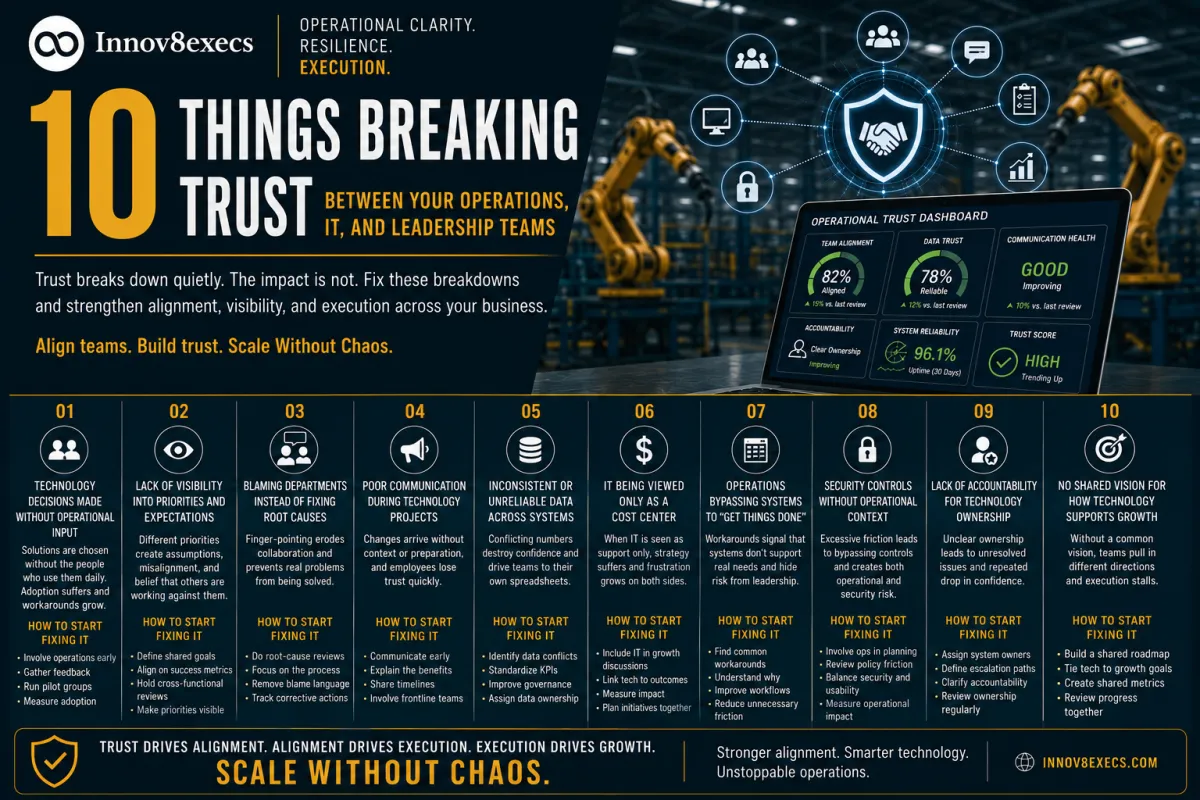
10 Things Breaking Trust Between Your Operations, IT, and Leadership Teams
Most manufacturing companies do not have a technology problem.
They have a trust problem.
Operations questions the reports.
IT questions the process.
Leadership questions the data.
Over time, those small fractures create operational friction that slows decision-making, weakens accountability, and limits growth.
The organizations that scale successfully are not simply aligned around technology. They are aligned around trust.
Toyota's success was never built solely on production systems or operational processes. It was built on creating visibility, accountability, and shared ownership across the organization.
That same principle still separates high-performing manufacturers from those constantly fighting internal friction.
Here are 10 things quietly breaking trust between your Operations, IT, and Leadership teams.
Breakdown 1: Technology Decisions Made Without Operational Input
When systems are selected without involving the people who use them every day, technology quickly feels imposed rather than supportive.
Employees become resistant because they were never part of the conversation.
The result is often poor adoption, inconsistent processes, and increased reliance on workarounds.
Easy First Steps
Include operational leaders early in technology discussions.
Gather feedback before major purchases.
Create pilot groups before full deployment.
Measure adoption alongside implementation success.
Technology adoption improves when people feel ownership.
Breakdown 2: Lack of Visibility Into Priorities and Expectations
Operations often prioritizes speed and uptime.
IT prioritizes stability and security.
Leadership prioritizes growth and profitability.
None of those goals are wrong.
Problems emerge when departments pursue them independently.
Without alignment, teams begin assuming other departments are creating obstacles rather than solving problems.
Easy First Steps
Create shared operational objectives.
Define success metrics across departments.
Hold regular cross-functional reviews.
Make priorities visible to the entire organization.
Trust improves when priorities are understood.
Breakdown 3: Blaming Departments Instead of Fixing Root Causes
Finger-pointing destroys trust faster than almost anything else.
When reporting issues, outages, delays, or integration failures occur, organizations often focus on assigning blame before understanding why the problem happened.
High-performing manufacturers focus on process improvement instead of departmental defense.
Easy First Steps
Conduct root-cause reviews after major issues.
Focus discussions on process failures.
Remove blame-oriented language from reviews.
Measure corrective actions, not fault.
Accountability grows when blame decreases.
Breakdown 4: Poor Communication During Technology Projects
Many projects fail long before go-live.
Employees lose confidence when system changes arrive without explanation, preparation, or visibility into why decisions were made.
People support what they understand.
They resist what appears to be happening to them.
Easy First Steps
Communicate project goals early.
Explain operational benefits clearly.
Share implementation timelines.
Involve frontline teams throughout the process.
Trust grows when communication is proactive.
Breakdown 5: Inconsistent or Unreliable Data Across Systems
Nothing destroys confidence faster than conflicting numbers.
When inventory reports differ from operational reports, or financial data conflicts with production data, people stop trusting systems.
Eventually they stop trusting each other.
Many spreadsheet cultures begin because employees no longer trust official data.
Easy First Steps
Identify conflicting reports.
Standardize KPI definitions.
Improve data governance.
Establish system ownership.
Reliable decisions require reliable information.
Breakdown 6: IT Being Viewed Only as a Cost Center
Organizations often treat IT as a support function rather than a strategic business partner.
That mindset creates frustration on both sides.
IT becomes reactive.
Leadership becomes disconnected from technology strategy.
Operations receives less strategic support.
Easy First Steps
Include IT in growth discussions.
Connect technology initiatives to business outcomes.
Measure technology contribution to operational performance.
Review strategic initiatives jointly.
Technology creates the most value when aligned to growth.
Breakdown 7: Operations Bypassing Systems to "Get Things Done"
Workarounds are often symptoms, not solutions.
Spreadsheets, manual processes, shadow systems, and undocumented workflows usually indicate that core systems no longer support operational reality.
When this happens, leadership loses visibility and consistency.
Easy First Steps
Identify common workarounds.
Understand why employees use them.
Improve workflows instead of enforcing compliance blindly.
Eliminate unnecessary friction.
Workarounds often reveal operational improvement opportunities.
Breakdown 8: Security Controls Implemented Without Operational Context
Security should protect operations.
It should not unnecessarily obstruct them.
When security controls create excessive friction, employees often develop ways around them.
That creates both operational and security risk.
Easy First Steps
Involve operational leaders in security planning.
Review policies creating workflow bottlenecks.
Balance protection with usability.
Measure operational impact alongside security outcomes.
Security succeeds when it supports operations.
Breakdown 9: Lack of Accountability for Technology Ownership
When ownership is unclear, problems remain unresolved.
Systems, integrations, workflows, and operational issues often fall into gray areas where nobody feels responsible.
Trust declines quickly when issues repeatedly go unresolved.
Easy First Steps
Assign ownership to critical systems.
Define escalation paths.
Clarify accountability for integrations.
Review ownership regularly.
Trust increases when responsibility is clear.
Breakdown 10: No Shared Vision for How Technology Supports Growth
Perhaps the biggest trust issue of all is a lack of shared direction.
Leadership talks about growth.
Operations talks about today's challenges.
IT talks about infrastructure.
Everyone is speaking about different goals.
The strongest manufacturers align all three around a common vision of operational success.
Easy First Steps
Build a technology roadmap tied to business growth.
Align technology initiatives to operational goals.
Create shared success metrics.
Review progress collectively.
Trust grows when everyone understands where the organization is going.
Final Thought
Most organizations do not lose trust overnight.
It erodes gradually through poor communication, unclear ownership, conflicting priorities, inconsistent data, and disconnected decision-making.
The result is not simply technology frustration.
The result is operational drag.
Workarounds increase.
Projects slow down.
Reporting gets questioned.
Departments become defensive.
Growth becomes harder than it should be.
The strongest manufacturers understand that trust is not a cultural initiative.
It is an operational advantage.
When Operations, IT, and Leadership share visibility, accountability, and common objectives, execution accelerates.
Problems get solved faster.
Technology delivers more value.
Growth becomes easier to sustain.
Toyota built one of the most respected operational systems in the world by creating visibility, accountability, and shared ownership across functions. Problems were surfaced instead of hidden. Teams worked toward common goals instead of protecting departmental interests.
That lesson remains just as relevant today.
The Scale Without Chaos Reality
The companies that scale successfully are not necessarily the ones with the most technology.
They are the ones that create alignment before complexity creates friction.
They reduce operational drag by building trust between the teams responsible for executing the business every day.
SCALE WITHOUT CHAOS
is not a technology strategy....It is a business strategy.
It means creating alignment between Operations, IT, and Leadership before internal friction limits execution.
When trust improves:
communication improves,
visibility improves,
accountability improves,
and execution improves.
If any of these breakdowns feel familiar, the problem may not be your technology.
It may be the trust gap quietly slowing your ability to grow.
