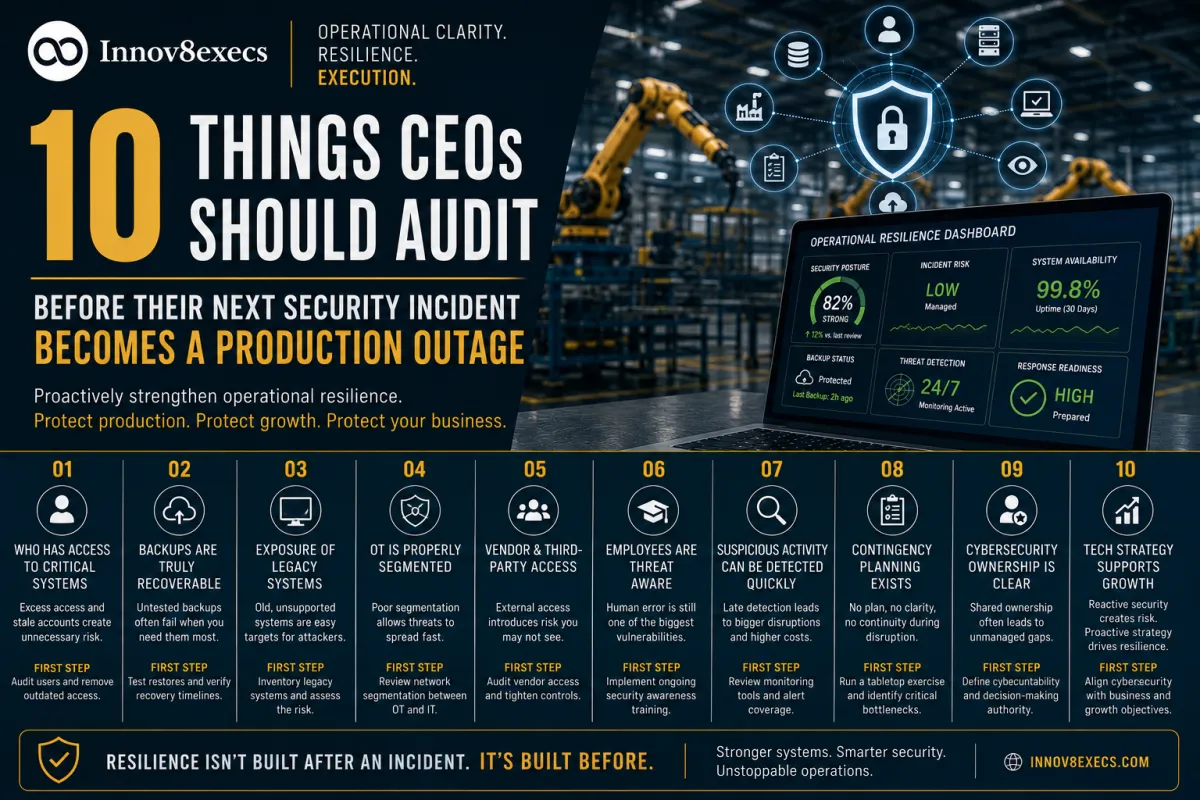
10 Things CEOs Should Audit
10 Things CEOs Should Audit Before Their Next Security Incident Becomes a Production Outage
Most manufacturing companies do not believe they have a cybersecurity problem until operations stop moving.
Production stalls. Orders delay. Systems lock. Vendors lose visibility. Customers demand answers. Leadership suddenly realizes the issue was never just about IT.
It was about operational resilience.
Modern manufacturing environments are more connected than ever:
ERP platforms,
production systems,
warehouse operations,
vendor integrations,
remote access tools,
cloud applications,
and operational technology environments all depend on each other operationally.
That connectivity improves efficiency.
It also increases operational exposure.
And many organizations quietly accumulate risk faster than leadership realizes.
The strongest manufacturers understand something many companies learn too late:
Cybersecurity is no longer just a technical discussion.
It is an operational continuity discussion.
Toyota’s operational philosophy emphasized resilience, process discipline, and visibility across production environments. That mindset remains critical today as manufacturing organizations become increasingly dependent on interconnected systems and digital operations.
Here are 10 things CEOs should audit before their next security incident becomes a production outage.
1. Who Actually Has Access to Critical Systems
Many organizations accumulate years of:
outdated employee accounts,
shared logins,
unnecessary permissions,
and lingering vendor access.
Over time, visibility into who can access critical systems becomes increasingly unclear.
And in manufacturing environments, one compromised credential can quickly impact:
production operations,
ERP systems,
inventory visibility,
procurement workflows,
and customer fulfillment.
Operational exposure often grows quietly through unmanaged access.
Easy First Steps
Audit active user accounts across critical systems.
Remove outdated employee and vendor access.
Eliminate shared credentials where possible.
Review privileged administrative permissions regularly.
Operational resilience begins with access control visibility.
2. Whether Backups Are Truly Recoverable
Many organizations believe backups automatically equal protection.
They do not.
Backups only matter if systems can be restored:
quickly,
completely,
and reliably during operational disruption.
Many manufacturers never test recovery procedures until production environments are already offline.
And that is often where operational downtime expands dramatically.
Easy First Steps
Test backup restoration procedures regularly.
Verify recovery timelines for critical systems.
Identify systems not included in backup processes.
Review backup retention and recovery priorities.
Recovery capability matters more than backup existence.
3. How Exposed Legacy Systems Really Are
Manufacturing organizations frequently continue operating:
aging ERP platforms,
unsupported operating systems,
legacy production equipment,
and outdated infrastructure because:
“It still works.”
But older systems often lack modern security protections and remain connected to operational environments that continue evolving around them.
Legacy infrastructure frequently becomes one of the largest operational risk areas inside manufacturing environments.
Easy First Steps
Inventory unsupported or aging systems.
Identify legacy platforms connected to operational networks.
Review systems lacking modern security controls.
Prioritize modernization based on operational exposure.
Technical debt eventually becomes operational risk.
4. If Operational Technology Is Properly Segmented From Business Systems
Production environments should not have unrestricted access to corporate networks.
When operational technology environments are poorly segmented, incidents can spread far beyond their original entry point.
This increases the potential impact across:
production,
inventory,
ERP,
warehousing,
and customer operations.
Operational segmentation helps contain disruption before it affects the entire organization.
Easy First Steps
Review network segmentation between OT and IT environments.
Limit unnecessary communication between systems.
Audit remote access pathways into production environments.
Identify operational systems exposed to broader corporate networks.
Containment is a critical part of operational resilience.
5. How Vendors and Third Parties Connect Into the Business
Many manufacturing environments rely heavily on:
remote support vendors,
managed service providers,
equipment manufacturers,
cloud integrations,
and third-party operational platforms.
Over time, these connections can quietly introduce operational exposure leadership no longer fully understands.
And many organizations underestimate how much access external parties maintain inside operational systems.
Easy First Steps
Audit third-party remote access permissions.
Review vendor authentication requirements.
Eliminate unused external connections.
Standardize vendor access approval processes.
Operational visibility should include external system access.
6. Whether Employees Are Trained to Recognize Modern Threats
Modern attacks increasingly target people instead of infrastructure first.
Phishing campaigns, MFA fatigue requests, impersonation attempts, and social engineering tactics now regularly target:
operational staff,
finance teams,
leadership,
and production personnel.
And manufacturing environments often prioritize operational continuity over security awareness.
That creates exposure.
Security awareness is no longer simply an HR exercise.
It is operational risk reduction.
Easy First Steps
Conduct phishing awareness training regularly.
Train employees on MFA fatigue and impersonation tactics.
Review incident reporting procedures.
Include operational teams in cybersecurity awareness initiatives.
Operational resilience improves when employees recognize threats early.
7. How Quickly the Organization Can Detect Suspicious Activity
Many organizations do not discover breaches until:
systems are encrypted,
operations are disrupted,
or customers are already impacted.
Delayed detection significantly increases:
downtime,
operational disruption,
recovery costs,
and customer impact.
Visibility matters.
The faster organizations detect operational abnormalities, the faster they can contain disruption.
Easy First Steps
Review system monitoring coverage.
Identify visibility gaps across operational systems.
Standardize alert escalation procedures.
Evaluate how incidents are currently identified and investigated.
Early detection reduces operational disruption significantly.
8. What Would Happen if ERP or Production Systems Went Offline Tomorrow
Most organizations have never fully tested operational continuity manually.
Leadership teams often assume operations can continue during disruption without fully understanding:
production bottlenecks,
manual workarounds,
inventory limitations,
communication gaps,
and dependency chains.
A cybersecurity event becomes significantly more dangerous when contingency planning does not exist operationally.
Easy First Steps
Conduct operational continuity tabletop exercises.
Identify critical operational dependencies.
Review manual fallback procedures.
Estimate how long core operations could continue during disruption.
Operational resilience requires preparation before disruption occurs.
9. Whether Cybersecurity Ownership Is Clearly Defined
One of the biggest operational risks inside manufacturing organizations is unclear accountability.
Responsibility often becomes fragmented across:
internal IT,
external providers,
operations teams,
vendors,
and leadership.
When ownership is unclear, gaps remain unmanaged.
Operational resilience requires someone inside the organization to own:
risk visibility,
operational continuity,
cybersecurity governance,
and long-term accountability.
Easy First Steps
Clarify operational cybersecurity ownership.
Define escalation and decision-making responsibilities.
Review vendor accountability structures.
Align cybersecurity discussions with operational leadership priorities.
Clear ownership reduces operational confusion during disruption.
10. If the Technology Strategy Supports Growth Instead of Reacting to Problems
Organizations that only address cybersecurity after incidents usually remain trapped in reactive operational cycles.
The strongest manufacturers approach cybersecurity strategically by aligning:
infrastructure,
operational continuity,
resilience,
scalability,
and business growth together.
Cybersecurity maturity is often a reflection of operational maturity.
And organizations that proactively reduce operational fragility usually scale with significantly less disruption.
Easy First Steps
Align cybersecurity priorities with business growth plans.
Review operational risks tied to expansion initiatives.
Identify systems creating operational fragility.
Build a long-term operational resilience roadmap.
The strongest manufacturing organizations do not treat cybersecurity as a side initiative.
They treat it as part of operational continuity and long-term scalability.
Final Thought
Most manufacturing organizations do not fail because of a single cybersecurity incident.
They fail because operational fragility already existed underneath the business before the incident occurred.
Disconnected systems. Weak visibility. Outdated infrastructure. Poor governance. Unclear ownership. Reactive planning.
Cybersecurity simply exposes the operational gaps already present.
The companies that scale successfully over the next decade will not necessarily be the ones spending the most on security tools.
They will be the ones building the strongest operational resilience.
Because operational continuity is no longer separate from cybersecurity.
It is one of the foundations that determines whether manufacturing organizations can scale confidently without disruption.
That is how manufacturers scale without chaos.
