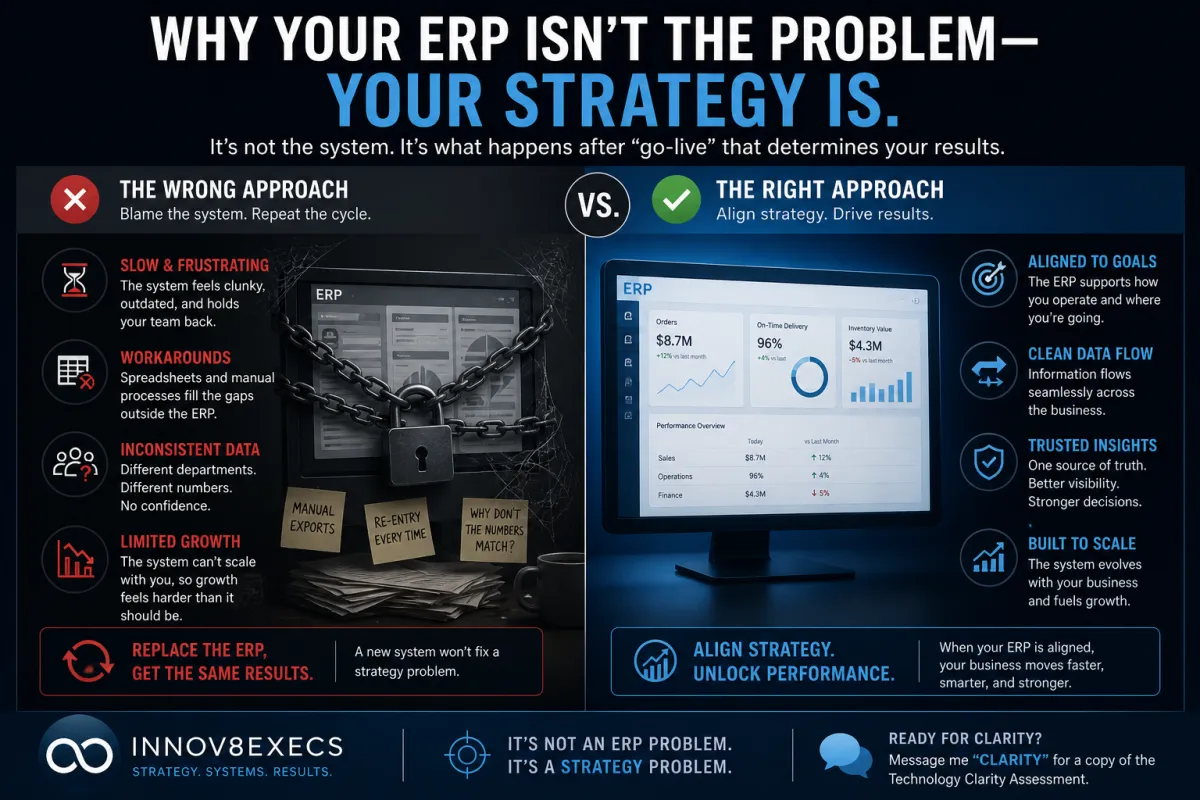
Why Your ERP Isn’t the Problem
Why Your ERP Isn’t the Problem—Your Strategy Is
At some point, almost every growing company says the same thing:
“Our ERP just isn’t working.”
It’s slow.
It’s clunky.
It doesn’t give the visibility you need.
The team complains about it constantly.
So the conversation starts:
Do we upgrade it?
Replace it?
Rip it out and start over?
The Assumption That Costs Millions
The assumption is simple:
If the system isn’t delivering, the system must be the problem.
But in most cases—that’s not true.
Because the ERP isn’t failing.
It’s doing exactly what it was set up to do.
What Actually Happens
Most ERP systems are implemented with one goal:
Get it live.
Migrate the data
Configure the basics
Train the team just enough to operate
And once it’s running?
The business moves on.
But what doesn’t happen is just as important:
No long-term strategy for how the ERP should evolve
No alignment with operational goals
No ownership of system performance over time
So the system becomes static…
While the business keeps changing.
The Real Gap
Over time, the gap grows between:
👉 What the business needs
and
👉 What the system was designed to support
That’s when you start seeing:
Workarounds outside the ERP
Spreadsheets replacing system functionality
Teams using the system differently across departments
Increasing frustration with “how things work”
And eventually:
“The ERP is the problem.”
Why Replacing It Usually Fails
Here’s the hard truth:
If you replace the ERP without fixing the strategy…
You just get a new system with the same problems.
Because the issue was never the tool.
It was:
Lack of alignment
Lack of ownership
Lack of clarity around what the system should actually deliver
What High-Performing Companies Do Differently
They don’t treat ERP as software.
They treat it as infrastructure for the business.
That means:
It’s aligned to how the company operates today
It evolves as the business grows
It’s measured against outcomes—not just uptime
Someone owns how it supports the business
The Questions Most Companies Aren’t Asking
Instead of asking:
“Do we need a new ERP?”
The better questions are:
What should our ERP be enabling today?
Where is it slowing us down?
Where are we working around it instead of through it?
What outcomes should it be driving in the next 12–24 months?
That’s where the clarity starts.
What “Good” Actually Looks Like
When ERP strategy is aligned:
Data flows cleanly across the business
Reporting reflects real performance
Teams operate from a shared process
Leadership has confidence in the numbers
The system becomes an asset.
Not a frustration.
The Shift That Changes the Outcome
You don’t fix ERP problems with more features.
You fix them with better alignment.
That requires:
Clear ownership
Ongoing optimization
A roadmap tied to business goals
Without that, even the best system will underperform.
Where to Start
Before you consider replacing anything, step back:
What is the ERP supposed to do for the business today?
Where is it not delivering?
Why are teams working around it?
Those answers will tell you more than any vendor demo ever will.
Final Thought
Most ERP problems aren’t system problems.
They’re strategy problems.
Call to Action
If you’re questioning whether your ERP is helping or holding you back—
That’s usually the signal.
I’ve built a Technology Clarity Assessment to help identify where systems, strategy, and operations are out of alignment.
If you’d like a copy, message me “CLARITY” and I’ll send it over.
