The Hidden Cost of “Good Enough”
The Hidden Cost of “Good Enough”
Nothing is broken.
That’s usually the problem.
Your systems are running.
Your team is getting work done.
Customers are being served.
From the outside, everything looks… fine.
But “fine” is one of the most expensive places a business can operate.
The Lie of “It Works”
In most manufacturing and distribution companies, technology doesn’t fail loudly.
It underperforms quietly.
Reports take longer than they should
Teams rely on manual workarounds
Systems don’t fully connect
Vendors operate in silos
No single issue is big enough to trigger urgency.
So the organization adapts.
And over time, that adaptation becomes normalized inefficiency.
Where the Money Actually Goes
The cost of “good enough” doesn’t show up as one obvious line item.
It spreads.
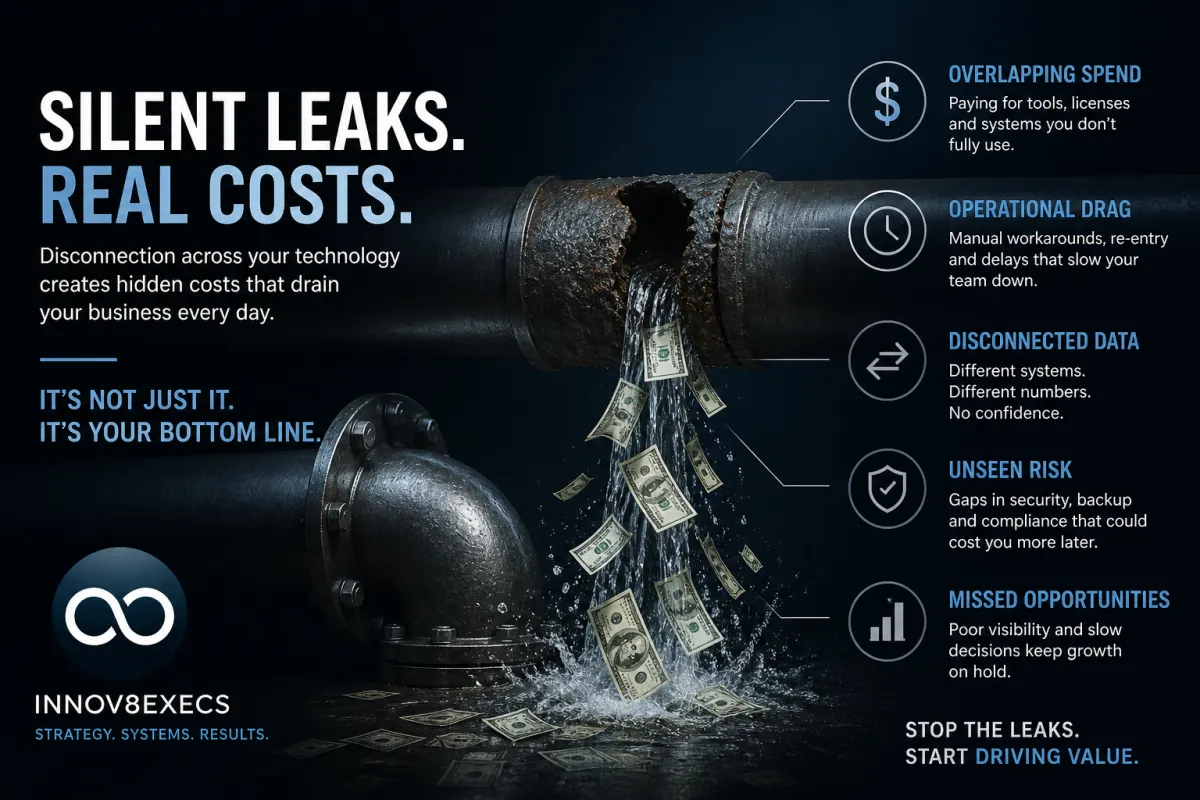
1. Overlapping Spend
You’re paying for:
Multiple tools that solve the same problem
Licenses that aren’t fully used
Legacy systems no one wants to touch
It’s not unusual to recover 15–30% of technology spend just by cleaning this up.
2. Operational Drag
Your team is working harder than they should have to.
Re-entering data across systems
Waiting on reports
Fixing issues manually
You don’t see this on an invoice.
You see it in:
Slower throughput
Higher labor cost per unit
Missed deadlines
3. Vendor Misalignment
Most vendors are doing exactly what they’re contracted to do.
The issue?
No one is aligning them to your business goals.
So you end up with:
Well-maintained systems that don’t move the business forward
Projects that complete… but don’t deliver impact
4. Unseen Risk
Security, backup, compliance—it’s all assumed to be “handled.”
Until it isn’t.
And by the time you find out, the cost isn’t just financial.
It’s operational.
Why This Keeps Happening
Because nothing forces the conversation.
There’s no outage.
No major failure.
No immediate crisis.
So leadership focuses on what’s urgent…
And “good enough” stays in place.
The Real Cost
Here’s the part most companies miss:
The biggest cost isn’t what you’re spending.
It’s what you’re not getting.
The efficiency you should have
The visibility you need
The scale you’re capable of
That gap compounds over time.
What High-Performing Companies Do Differently
They don’t wait for failure.
They challenge “fine.”
They ask:
Why does this take this long?
Why are we paying for this?
Why don’t these systems connect?
What should this actually be doing for us?
And most importantly:
They assign ownership to those answers.
A Better Way to Look at Technology
Technology shouldn’t be evaluated by:
“Is it working?”
It should be evaluated by:
“Is it driving the business forward?”
That’s a very different standard.
Where to Start
You don’t need to rip everything out.
You need visibility.
What are we paying for?
What are we actually using?
Where are we inefficient?
Where are we exposed?
Most companies don’t have clear answers.
And that’s where the opportunity is.
Final Thought
“Good enough” technology rarely breaks a business overnight.
It just slowly keeps it from becoming what it could be.
