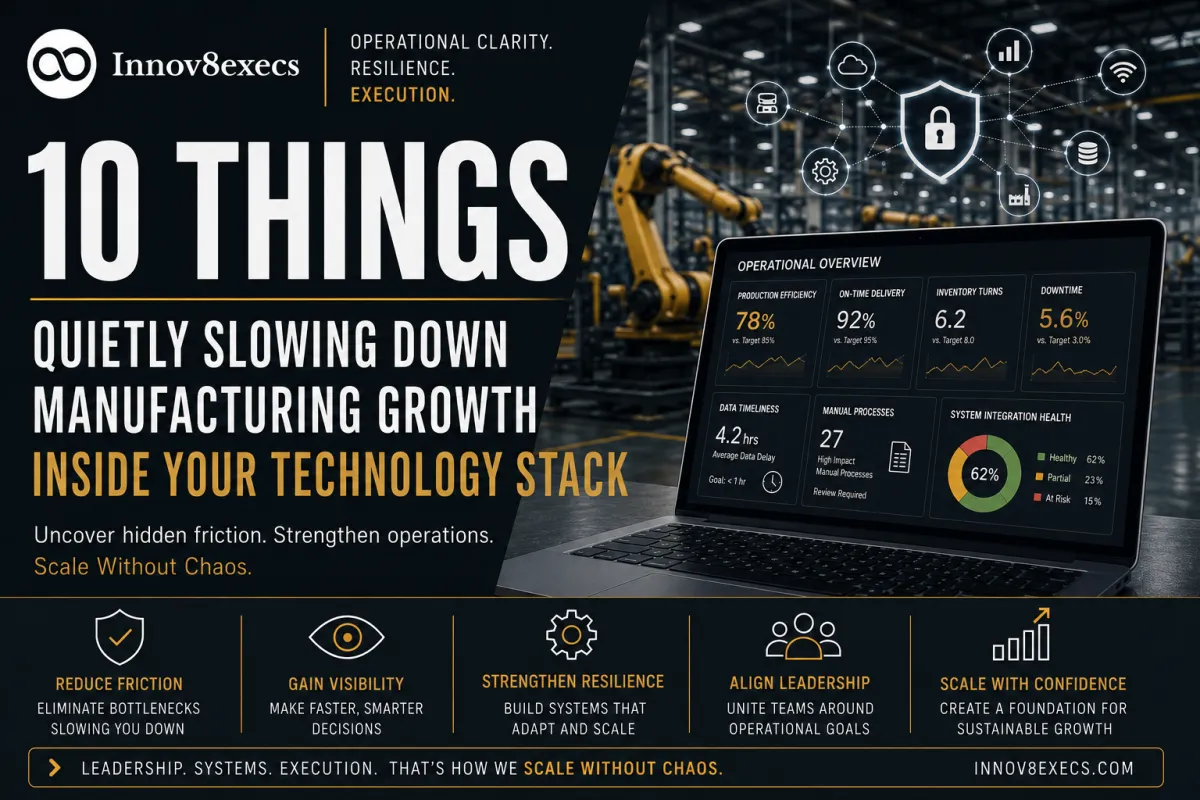
10 Things Quietly Slowing Down Manufacturing
10 Things Quietly Slowing Down Manufacturing Growth Inside Your Technology Stack
Most manufacturing companies do not hit growth ceilings because demand disappears.
They hit growth ceilings because operational friction compounds quietly over time.
Disconnected systems. Spreadsheet workarounds. Reporting delays. Manual approvals. Aging infrastructure. Visibility gaps. Conflicting workflows. Reactive technology decisions.
Individually, these issues may seem manageable.
Together, they create operational drag that slows execution, limits scalability, frustrates employees, and makes growth increasingly difficult to sustain.
And the challenge is that most organizations do not notice the problem immediately.
Operational friction rarely breaks the business all at once.
It accumulates quietly until leadership begins feeling:
slower decision-making,
operational inconsistency,
customer frustration,
reduced visibility,
and increasing complexity across the organization.
The manufacturers that scale successfully understand something many companies learn too late:
Growth is not just about adding capacity.
It is about reducing friction.
Toyota’s operational success was never built purely on technology. It was built on visibility, process consistency, operational flow, and continuous improvement across the organization.
That philosophy matters even more today as manufacturing environments become increasingly connected and operational complexity continues growing.
Here are 10 things quietly slowing down manufacturing growth inside your technology stack and where leadership teams can begin reducing operational drag before it limits scalability.
1. Too Many Disconnected Systems
Many manufacturing organizations operate with systems that technically function but operationally do not work together well.
ERP, CRM, inventory, production, procurement, and shipping platforms often contain overlapping information that employees constantly reconcile manually.
As companies grow, disconnected systems create:
duplicated work,
inconsistent reporting,
delayed decisions,
and operational confusion.
Operationally mature manufacturers focus on flow between systems and teams. Toyota’s production philosophy emphasized visibility, standardization, and operational alignment long before digital transformation became a buzzword.
Disconnected systems are often symptoms of disconnected operational ownership.
Easy First Steps
Identify where teams manually transfer data between systems.
Audit duplicate reporting processes.
Map operational bottlenecks between departments.
Review which systems create the most employee friction.
Operational flow matters more than the number of systems in place.
2. Spreadsheet Dependency Across Critical Processes
Spreadsheets often become the unofficial operational glue holding businesses together.
At smaller scale, this may feel manageable.
But as organizations grow, spreadsheet-driven processes create:
version-control issues,
manual reporting delays,
inconsistent data,
and operational dependency on individual employees.
Many companies do not realize how fragile operational workflows have become until reporting errors, employee turnover, or scaling pressure exposes the problem.
What works at $5M in revenue rarely scales effectively at $50M.
Easy First Steps
Identify spreadsheets supporting mission-critical operations.
Review where manual data entry still exists.
Standardize reporting ownership.
Prioritize automation around high-friction workflows first.
Operational resilience improves when knowledge lives inside systems, not isolated spreadsheets.
3. Legacy Infrastructure Nobody Wants to Touch
Many manufacturers continue operating on aging infrastructure because:
“It still works.”
But operational stability and operational scalability are not the same thing.
Outdated servers, unsupported software, aging production systems, and heavily customized environments quietly create:
maintenance complexity,
integration limitations,
visibility gaps,
cybersecurity exposure,
and operational risk.
Technical debt compounds operational friction over time.
Organizations often underestimate how much growth flexibility is being constrained by infrastructure decisions made years earlier.
Easy First Steps
Create an inventory of aging or unsupported systems.
Identify systems with no recovery or redundancy plan.
Prioritize modernization based on operational risk.
Review which legacy systems create the most workflow dependency.
Technology debt eventually becomes operational debt.
4. Lack of Visibility Into Real-Time Operations
Leadership teams cannot make fast decisions using delayed information.
When operational data arrives hours or days late, organizations become reactive instead of strategic.
This impacts:
production planning,
inventory management,
forecasting,
customer communication,
and operational responsiveness.
Many manufacturers believe they have visibility because reports exist. The real question is whether leadership trusts the data enough to make fast decisions confidently.
Operational visibility is not about dashboards alone.
It is about trusted operational flow.
Easy First Steps
Identify where reporting delays occur.
Review how long operational data takes to reach leadership.
Standardize KPI definitions across departments.
Reduce manual reporting dependencies.
Visibility improves when operational systems communicate consistently.
5. Over-Customized ERP Environments
ERP customizations often begin with good intentions:
solving operational problems quickly.
Over time, however, heavily customized environments become fragile ecosystems that are increasingly difficult to:
upgrade,
integrate,
support,
or scale.
Eventually, the business adapts to the limitations of the system instead of the system supporting the business operationally.
Many organizations discover years later that customization decisions quietly increased operational complexity across the enterprise.
Easy First Steps
Inventory unsupported ERP customizations.
Review manual workarounds created around ERP limitations.
Identify integrations dependent on custom code.
Prioritize simplification before expansion initiatives.
Operational scalability improves when systems remain adaptable.
6. Technology Decisions Made Department by Department
Operational fragmentation often begins with decentralized decision-making.
Operations buys one platform. Finance buys another. Sales introduces a CRM. Warehousing implements separate tooling. IT inherits the complexity afterward.
Individually, these decisions may solve local problems.
Collectively, they often create:
duplicate systems,
conflicting workflows,
inconsistent reporting,
and operational silos.
Disconnected systems frequently reflect disconnected leadership priorities.
Easy First Steps
Review duplicate platforms across departments.
Establish cross-functional technology governance.
Align technology decisions to operational goals.
Identify where conflicting workflows exist between teams.
Operational clarity requires leadership alignment before system alignment.
7. Poor Cybersecurity Hygiene Creating Operational Risk
Weak cybersecurity practices create more than security exposure.
They create operational instability.
As manufacturing systems become increasingly interconnected, cybersecurity issues now directly impact:
uptime,
production continuity,
vendor trust,
customer confidence,
and supply chain reliability.
One disruption can stall operational momentum for months.
Manufacturing environments remain attractive targets because operational downtime creates leverage. Operational resilience and cybersecurity are increasingly inseparable in modern manufacturing environments.
Easy First Steps
Audit shared accounts and outdated access permissions.
Review third-party vendor access.
Require MFA across critical systems.
Test backup and recovery procedures regularly.
Cybersecurity is now part of operational continuity planning.
8. Manual Approval and Reporting Bottlenecks
Many organizations still rely heavily on:
emailed spreadsheets,
paper approvals,
manual reporting cycles,
and disconnected communication processes.
These workflows quietly slow execution across the business.
As organizations grow, decision latency compounds operational drag significantly.
Scaling manufacturers require systems that accelerate execution, not slow it down through unnecessary friction.
Easy First Steps
Identify approval workflows causing delays.
Map manual reporting dependencies.
Review repetitive operational tasks.
Prioritize automation around high-frequency bottlenecks.
Operational speed often improves by reducing friction, not increasing activity.
9. Underinvesting in Employee Training and Adoption
Even strong systems fail when employees do not understand how to use them effectively.
Many organizations blame software for problems that are actually caused by:
inconsistent workflows,
poor process ownership,
limited training,
and lack of operational adoption.
Technology only improves operations when teams understand how systems support operational execution consistently.
Operational maturity requires process discipline across the organization.
Easy First Steps
Review inconsistent system usage across departments.
Standardize operational workflows.
Improve onboarding around core systems.
Train leadership teams alongside operational teams.
Systems scale best when people trust and understand them.
10. No Long-Term Technology Roadmap Tied to Business Growth
Many manufacturers buy technology reactively instead of strategically.
New systems are added to solve immediate problems:
acquisitions,
reporting gaps,
operational pain points,
customer demands,
or scaling pressure.
Over time, reactive decisions create operational complexity without clear operational alignment.
The organizations that scale successfully tie technology decisions directly to:
business goals,
operational flow,
scalability,
resilience,
and leadership priorities.
Growth exposes operational friction faster than most organizations expect.
Easy First Steps
Build a technology roadmap aligned to growth goals.
Identify operational constraints limiting scalability today.
Review systems creating duplicate work.
Establish long-term governance around operational technology decisions.
The strongest manufacturers do not scale because they adopt the most technology.
They scale because they reduce operational friction consistently.
Final Thought
Most manufacturing companies do not need more technology.
They need more operational clarity.
Disconnected systems, spreadsheet dependency, reporting delays, operational bottlenecks, and technology fragmentation are often symptoms of something deeper:
an organization that has outgrown the operational structure supporting it.
The companies that scale successfully over the next decade will not necessarily be the ones with the largest technology stack.
They will be the ones with the least operational friction.
That philosophy helped shape some of the most operationally efficient manufacturers in the world long before modern ERP ecosystems existed.
Because operational resilience is not built through software alone.
It is built through clarity, visibility, alignment, and disciplined execution across the organization.
That is how manufacturers scale without chaos.
