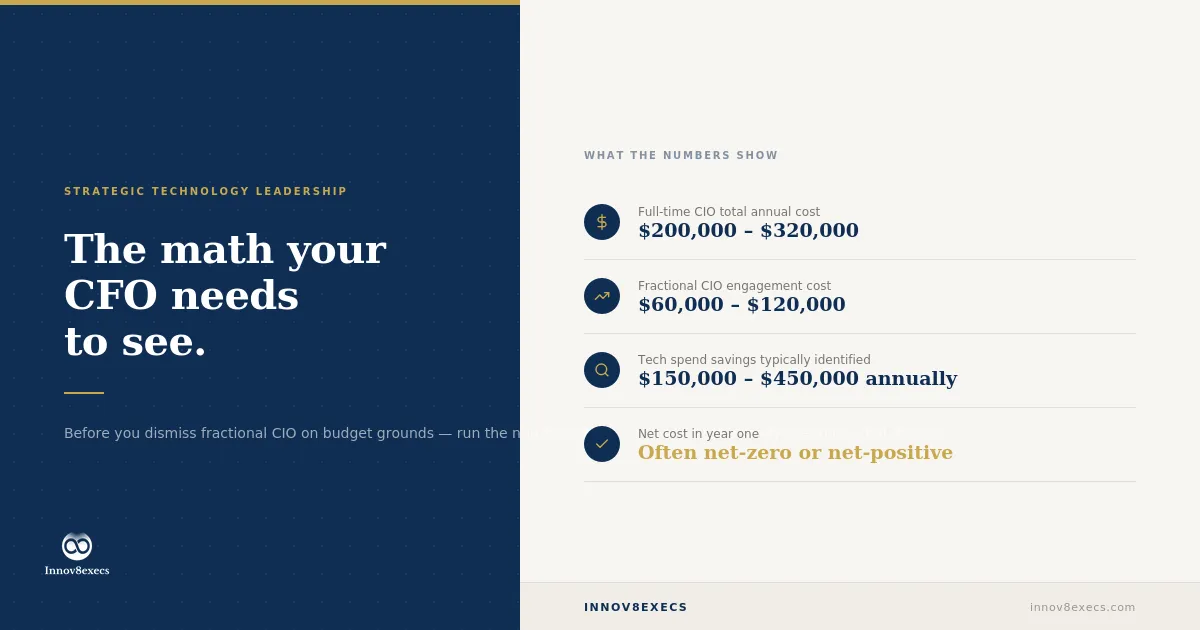
The math your CFO needs
The math your CFO needs to see on fractional CIO
Fractional CIO · Strategy · May 2026 · 6 min read
The conversation usually goes one of two ways. Either a CFO tells me they can't justify the cost of a CIO right now, or they tell me they already have someone handling technology — an IT manager, maybe an outsourced MSP — and they're not sure what a fractional CIO would add.
Both objections make sense on the surface. And both of them tend to fall apart pretty quickly when you actually sit down and look at the numbers.
So let's look at the numbers.
What a full-time CIO actually costs
A full-time CIO at a mid-market manufacturing or distribution company — somewhere in the $50M to $300M revenue range — runs between $150,000 and $250,000 in base salary. Add benefits, employer-side taxes, and any equity or bonus structure, and you're realistically looking at $200,000 to $320,000 in total annual cost for a single executive seat.
That's before you factor in recruiting fees (typically 20–25% of first-year salary), the 60 to 90 days it takes a new hire to get oriented, and the very real possibility that the hire doesn't work out and you do it again.
Most mid-market companies don't need a CIO 40 hours a week. They need someone to set technology direction, build the roadmap, manage vendors and internal teams to execute it, and make sure the business isn't exposed to risks it doesn't know about. That is not a full-time job at most companies in this revenue range. It's a strategic function, not an operational one.
Where the money is already going — and disappearing
Here's what almost every technology audit of a mid-market company turns up: somewhere between 15% and 30% of their technology spend is producing no meaningful return. Not because the technology is bad. Because nobody is strategically managing it.
The culprits are predictable. Duplicate software licenses — two teams solving the same problem with different tools that were never rationalized. Systems that don't talk to each other, so data gets re-entered manually or reports get pulled by hand. Vendor contracts that auto-renewed at rates that haven't been reviewed in three years. Infrastructure sized for a company they used to be, not the one they are now.
None of this is anyone's fault. It's what happens when technology scales alongside a business without someone at the leadership level whose job is to look at the whole picture. The IT manager is managing tickets and keeping the lights on. The MSP is maintaining what they've been contracted to maintain. Nobody is asking whether the strategy still makes sense.
What a technology audit typically finds
Duplicate systems — multiple tools doing the same job across different departments, often acquired organically as teams grew.
Integration gaps — data that moves manually between systems that should be connected, consuming staff time and introducing errors.
Stale vendor contracts — agreements on auto-renewal that haven't been benchmarked against current market rates.
Over-provisioned infrastructure — compute and storage capacity sized for yesterday's workload, not today's.
Shadow IT — tools purchased by individual departments outside IT visibility, creating security exposure and redundancy.
The side-by-side comparison
Let's put both options on paper for a company running $75M in annual revenue with a technology budget of roughly $1.5M.
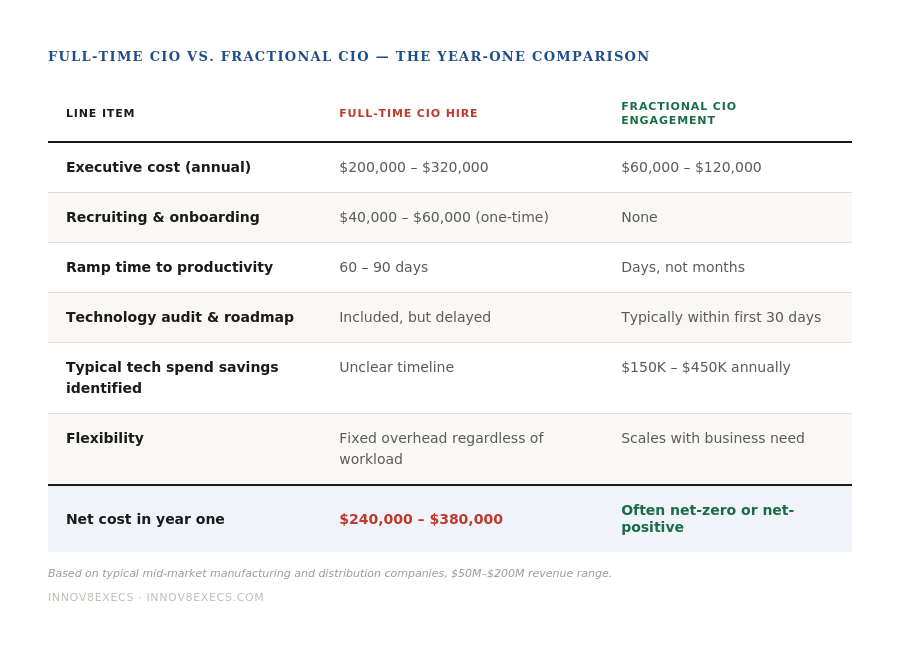
Figures based on typical mid-market manufacturing and distribution companies, $50M–$200M revenue range.
The math isn't subtle. The fractional engagement costs significantly less on its own — and it typically pays for itself through savings identified in the first audit cycle. In many cases, the savings identified in year one exceed the cost of the engagement by a meaningful margin.
What "strategic oversight" actually means in practice
It's worth being clear about what a fractional CIO does and doesn't do. This is not a hands-on technical role. A fractional CIO is not running your help desk, configuring your servers, or writing code. Your internal team and your MSP do that.
The fractional CIO's job is to make sure those people are executing the right strategy. That means:
Setting the direction. What technology investments should the company be making over the next 12 to 36 months? Which vendor relationships serve the business and which ones need to be renegotiated or replaced? What does the roadmap look like, and how does it connect to business outcomes?
Managing the risk. Where are the security exposures? What happens if a key system goes down? Are there compliance requirements the business needs to be tracking? What's the recovery plan if something goes wrong?
Translating between technology and the business. A fractional CIO sits at the table with the rest of your leadership team. When a vendor pitches a new system, there's someone who can evaluate it honestly. When the board asks about technology risk, there's someone who can answer. When the CFO wants to understand why the IT budget is what it is, there's someone who can explain it in business terms.
The question CFOs should actually be asking
The right question isn't "can we afford a fractional CIO?" It's "can we afford not to have one?"
If your technology spend is $1M or more annually and nobody at the leadership level is actively managing the strategy behind it, you are almost certainly losing meaningful money to inefficiency. The question is whether you'd rather find that out proactively — and fix it — or find out because something went wrong.
A technology audit in the first 30 to 60 days of a fractional engagement typically identifies enough savings to offset the cost of the engagement in the first year. Sometimes significantly more than that. The work then shifts to execution: making sure those savings are captured, and that future technology decisions are made with the same strategic clarity.
That's the fractional advantage. You get the strategic oversight. You get the cost reduction. You pay for it with money you're already losing.
Ready to run the numbers for your business? A 30-minute conversation is usually enough to identify whether a fractional CIO engagement makes sense — and what it might return in year one. Worth a conversation?
