Why Your Systems Don’t Talk
Why Your Systems Don’t Talk—And What It’s Costing You
Most companies don’t think they have an integration problem.
They just feel the symptoms.
Reports take longer than they should
Teams double-check numbers before making decisions
The same data exists in multiple places
Leadership spends more time validating information than acting on it
Nothing is technically broken.
But nothing flows.
The Friction You Can’t See (But Feel Every Day)
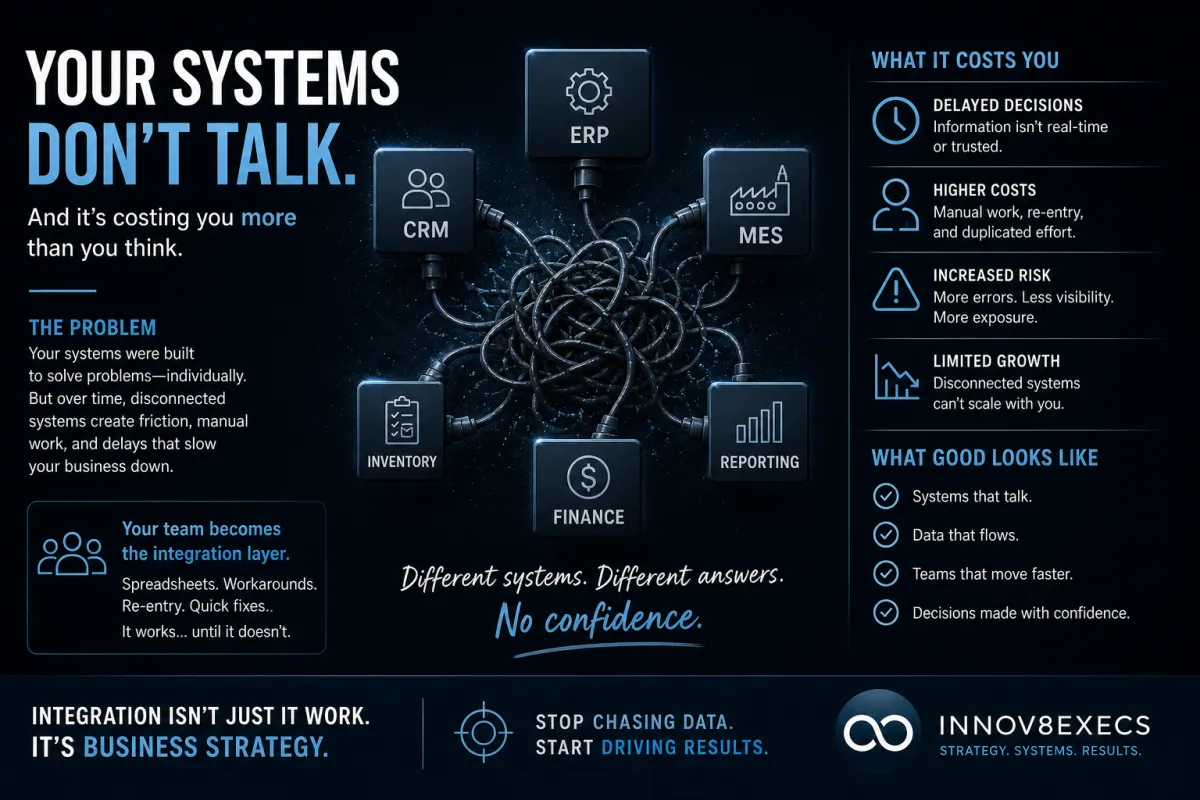
In most manufacturing and distribution companies, systems were added over time to solve specific problems:
ERP to run operations
CRM to manage customers
MES or shop floor systems
Finance and reporting tools
Inventory and warehouse platforms
Each decision made sense at the time.
Individually, these systems often perform well.
But collectively, they create friction.
Not because they’re bad…
But because they were never designed to work together.
Where This Shows Up in the Real World
You don’t call it an “integration issue.”
You call it:
“Why does this take so long?”
Your team exports data, cleans it up, and rebuilds reports manually.
“Which number is right?”
Finance, operations, and sales all have slightly different answers.
“Why are we always behind?”
By the time you get visibility, it’s already outdated.
“Why does growth feel harder than it should?”
What worked at $10M starts to strain at $25M—and becomes a bottleneck at scale.
The Workaround Trap
When systems don’t talk, your people compensate.
They become the integration layer.
Spreadsheets connect what systems don’t
Manual processes fill in the gaps
Tribal knowledge replaces structured data flow
It works… temporarily.
But over time, it creates:
Higher labor costs
Slower execution
Increased risk of errors
Dependence on specific individuals
And most importantly:
It hides the real problem.
The Real Cost of Disconnected Systems
This isn’t just a technology issue.
It’s an operational and financial issue.
Disconnected systems lead to:
Delayed decision-making — because data isn’t trusted
Reduced efficiency — because work is duplicated
Limited visibility — because information is fragmented
Slower growth — because the business can’t scale cleanly
And here’s the part most companies underestimate:
Once leadership loses confidence in the data, everything slows down.
Why This Problem Persists
Because no one owns it.
Each system has:
A vendor
A purpose
A team responsible for using it
But no one is accountable for:
How everything works together.
So integration becomes:
Reactive
Inconsistent
“Good enough”
Until it becomes a constraint on the business.
What High-Performing Companies Do Differently
They don’t just implement systems.
They orchestrate them.
Data flows automatically across platforms
Systems are aligned to business processes
Reporting reflects real-time performance
Teams trust what they see
Technology becomes an enabler—not a bottleneck.
The Shift That Changes Everything
This isn’t about buying new tools.
It’s about designing how your systems work together.
That requires:
Clear ownership
Intentional data flow
Alignment between operations, finance, and technology
Without that, adding more systems just adds more complexity.
Where to Start
You don’t need to overhaul everything overnight.
Start by identifying the friction:
Where is data being re-entered?
Where do numbers not match?
Where are decisions delayed waiting on information?
Those are your integration gaps.
And they’re usually closer—and more fixable—than you think.
Final Thought
Disconnected systems don’t fail loudly.
They just make everything harder than it should be.
Call to Action
If your team is spending more time chasing data than using it, that’s usually the signal.
I’ve built a Technology Risk Assessment to help identify where systems, data, and processes are out of alignment.
If you’d like a copy, message me “CLARITY” and I’ll send it over.
